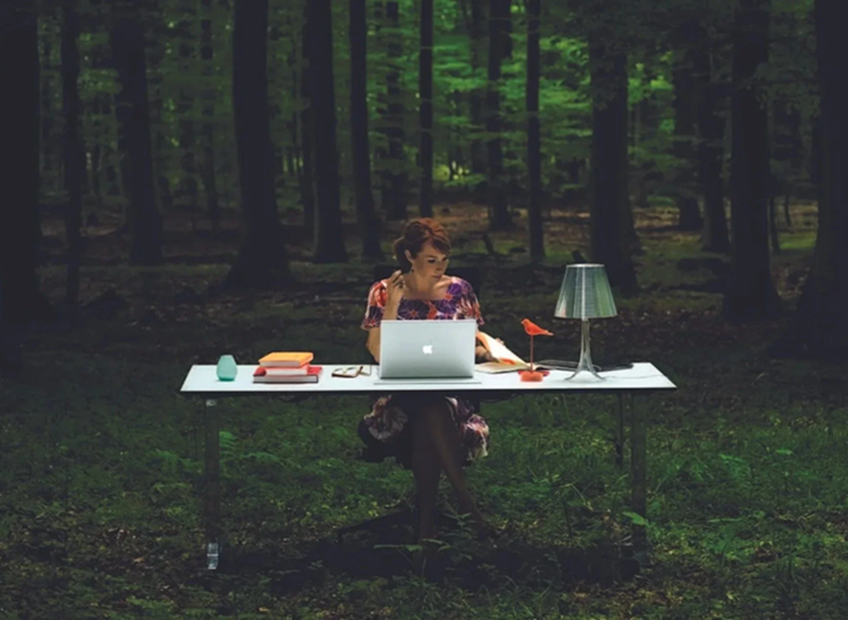
Move the office into nature - and nature into your office spaces

New feature! Listen to this article as a podcast
As summer approaches, office employees begin longing for outdoor opportunities to work and perform outdoors under the open sky.
Biophilic space design is an increasingly popular concept that focuses on uniting indoor workplaces with nature to improve well-being, creativity and overall employee performance.
Natural light and air, green spaces, natural eco-friendly materials, organic shapes, and views of nature are biophilic cornerstones of healthy, comfortable and inspiring workplaces.
Amid the often alienating technologies of the modern workday, biophilic design focuses on employees’ needs for mental, physical and emotional well-being through natural materials and processes.
The power of nature
"Today's office work, thanks to AI and other new technologies and processes, has developed into a hard, concentrated load, where the old routine things, when you could just rest your brain for a moment, are gone. Now it's about efficiency in top gear and all the time.
That's why we office workers need surroundings and things around us that can help us recover, make us relax mentally and gather new energy and inspiration while we perform and solve our work tasks," CEO at Danish LAIKA Space Design, Lene Becker Bang, says.
  Biomorphic space design has become an increasingly popular concept that focuses on connecting indoor workspaces with nature, and biomorphic shapes and creating variety in the often square office environments. Photos: LAIKA Rumdesign |
"Biophilic design is often reduced to a few plants in the corners, perhaps a green wall in the reception area, but biophilia is an important strategic approach to shaping spaces so that they support our ability to sense, recover, focus and orient ourselves intuitively in our surroundings.
Biophilia is based on the simple realisation that when we remove ourselves from nature, we also remove ourselves from some of the conditions under which humans function best.
I often use Kellogg's old sales slogan, "Have you forgotten how good it tastes?" when I talk about biophilic design. We know very well how deep down we thrive with natural surroundings and organic things and shapes around us," Lene Becker Bang adds.
Increasing creativity
In recent years, LAIKA has focused more on helping corporate clients furnish their offices with biophilic designs that improve concentration, calm, and presence, leading to better communication, decisions, and productivity.
Research studies show that natural surroundings reduce stress and lower the body's cortisol level by up to 16%, and natural elements help the brain recover and re-establish focus.
Spending time in natural environments can improve creative problem solving by up to 50%, and employees with natural elements around them at work report 13% higher well-being and 8% higher productivity.
 "First and foremost, we must bring nature directly into play as an active quality in the space - daylight, plants, air, sound and water are staged so that it is not only present, but experienced," CEO at LAIKA Space Design, Lene Becker Bang, says. |
"We often experience how a neutral meeting room can completely change its character when daylight, materiality and view are brought into play. Suddenly, a quality emerges that needs no explanation.
It becomes a room you want to stay in not because someone said so, but because your body has already understood it," Lene Becker Bang says.
Bring nature into play
LAIKA Space Design bases its approach to biophilic design of corporate office spaces and environments individually on a number of consistent focus points.
First and last, nature must be brought directly into play as an active quality in the space: daylight, the movement of light through the space, planting, plant shadows, access to outdoor areas.
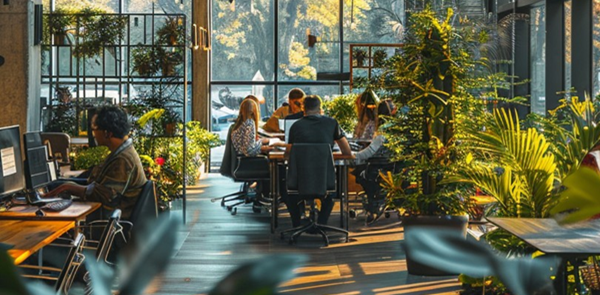
 Most workplaces can’t turn their space into a full “rainforest,” but even small offices can add a similar feel. Try using organic shapes, light and sheer curtains, or rugs with unique shapes instead of just squares. Photo: StockCake |
"Biophilic design is not just an "opinion", but thorough and solid research, I refer to - it is a strategic way to articulate the human being in the space, to make them want to stay and thrive in the office - every day.
Not all workplaces have the opportunity or means to place an entire "rainforest" in their space, but smaller ones can do it too: Organic shapes, light, bright transparent curtains, rugs that wave or have shapes other than square.
Nature's own materials such as wood and stone, organic shapes, tactile surfaces, patterns inspired by nature's structures create sensory recognition in the atmosphere and mood of the workspace," Lene Becker Bang emphasises. ●



Read more:
Laika-rumdesign.dk: Should we move the office out to the woods
Coel.co.uk: Biophilia - nature’s influence on office design
Freeofficefinder.com: What is a biophilic office design - a detailed guide
Journalofbiophilicdesign.com: A biophilic reinvention of the modern office