This desk robot might become your best office colleague

New feature! Listen to this article as a podcast
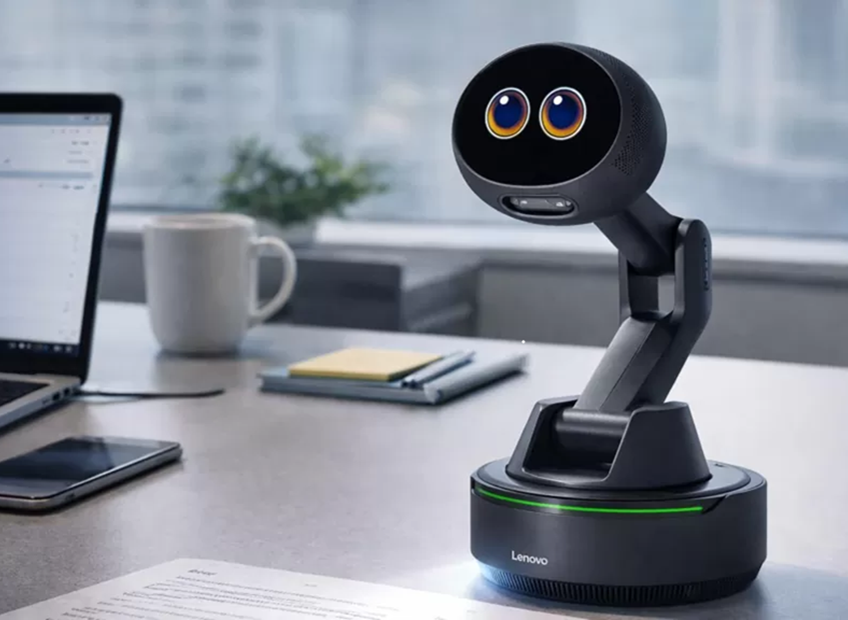
AI Workmate is your future office colleague, who could prove to be an absolutely indispensable part of your future desk and your workday.
In the spring, technology giant Lenovo presented its new AI Workmate Concept - an 'always-on desk companion' - which processes all AI queries locally on the device itself instead of sending data to cloud servers.
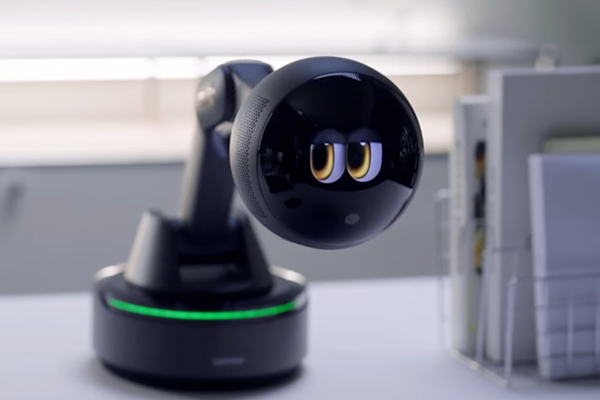
The small desktop robot has a 3.4" LCD screen as a face, cameras and a Pico projector mounted on an articulating arm with a rotating base. It has access to your office communications and work files and can answer questions about your projects, incoming messages and updates from your team.
Your future workmate is designed to stand on your desk, respond to voice and gesture commands and recognise and respond to what you write or sketch for it on a piece of paper.
Cobots
The AI Workmate Concept was showcased at this spring's big MWC26 technology fair in Barcelona, but Lenovo has not yet announced plans to put the desk robot into production.
"Lenovo's small smart desk robot could be a bid for your future personal assistant, as it is able to synchronise with all your information from calendar, emails and other documents and dress you well with details," industry experts assess.
 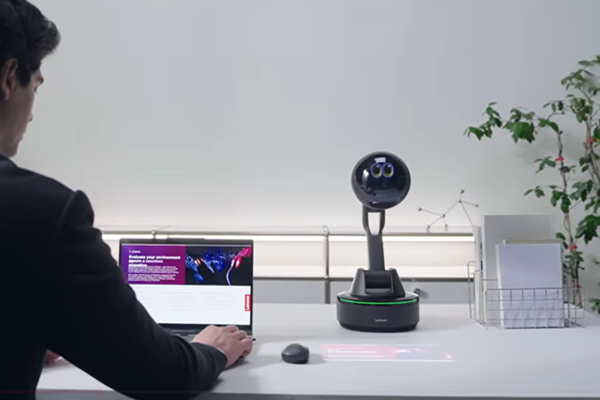 Lenovo AI Workmate is designed to sit on your desk, respond to voice and gesture commands, and recognise and respond to what you write or sketch on paper. |
The new AI-powered robots are no longer just automated machines, but are based on general physical AI systems that can learn, adapt and operate in human environments in real time.
Cobots, also known as collaborative or cooperating robots, are machines designed to work closely with or alongside human employees in the same workspace on the same tasks.
Physical AI
Physical AI is artificial intelligence embedded in physical machines that uses sensors to understand the real world in real time, enabling them to navigate, adjust grips and perform complex physical tasks autonomously.
While generative AI lives in the digital world and learns from existing text, images, and code, physical AI must create physical training data from scratch through simulation, sensor detection, and real-world interaction.
 Cobots, aka collaborative or cooperating robots, are machines designed to work closely with or with companies' human employees on the same tasks in the same workspace. |
Physical AI thus moves from pre-programmed movements to self-learning behaviour that enables robots to understand context, recognise objects and people, predict events, and plan complex actions.
This enables them to solve tasks that previously required human judgment - for example, robots that find the best route through a warehouse, drones that analyse their surroundings and adjust their flight in real time, or care robots that can adapt to individual human needs. ●

Read more:
Youtube.com: Introducing the Lenovo AI Workmate - your reliable AI work companion
Robot-magazine.fr: Lenovo AI Workmate - AI that turns your gestures into digital actions
Forbes.com: Capgemini warns CEOs - physical AI can no longer be ignored
Towardsdatascience.com: Physical AI - what it is and what it is not